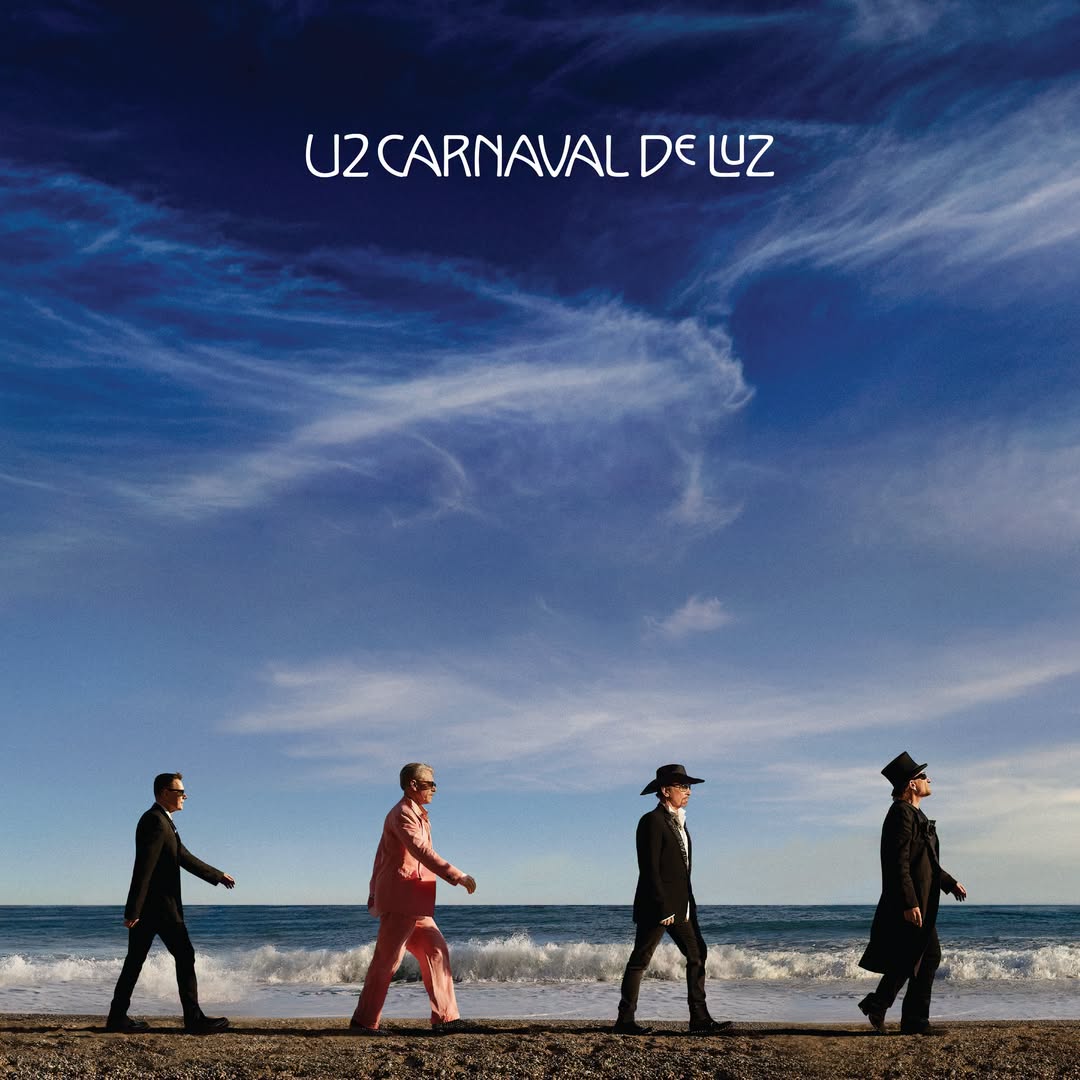
I’ve lost count of the artists I had high hopes for who ran out of steam by their second or third album. And then there’s U2. To mark their 50th anniversary, they’ve made a record that might not quite be up there with The Joshua Tree or Achtung Baby, but plays off both in interesting ways and finds the band in fine form. Taken together, Carnaval de Luz and its two companion EPs, Days of Ash and Easter Lily, are easily the most interesting music U2 have put out in at least 20 years.
A little context first. For plenty of people, U2 have come to embody the kind of music that feels more like a mass-market product than a labour of love. Automatically adding Songs of Innocence to people’s iTunes libraries hardly helped, and neither did Fireflies, their recent, decidedly commercial single with Martin Garrix. I still see the band a little differently.
When I think of U2, I picture a scene from the 2008 documentary It Might Get Loud. The Edge is in the kitchen of his Dublin home, playing back old demos on a little four-track recorder. You can hear how much he loves making music just from the way he talks about those songs and how he wrote them. I get that same feeling from the interviews U2 have given around Carnaval de Luz. Whether they’re talking to Zane Lowe in the corridors of Mount Temple, the school where the band met, or sitting down for a remarkably frank interview with The New York Times, what struck me was how much Bono and The Edge care about the things they’re discussing - the new songs, their friendship, their faith and what’s been happening in the world around them.
All of that found its way into the music. With Jacknife Lee producing and Brian Eno lending a hand, the band came away with 24 tracks across the two EPs and the standard edition of Carnaval de Luz.
Which raises a question - with that many songs, would they have been better off picking the strongest and making one album? The band say each release tells its own story, and I can see their point. Days of Ash, released on Ash Wednesday, might be the most politically outspoken collection of anti-war songs U2 have ever made. Its songs tell the stories of people caught up in violence in Minneapolis, Iran, Palestine and Ukraine. Easter Lily arrived on Good Friday and turns to friendship, grief and faith. Then there’s Carnaval de Luz - an ecstatic record that simply wants to bring a little joy into the world.
That split makes sense to me, especially since, on musical merit alone, some of the EP tracks would probably have ended up as single B-sides back in the ’90s. There are exceptions. I’d have loved a place on the album for American Obituary, a rock anthem whose rousing choral finale brings Patti Smith’s People Have the Power to mind: “The power of the people is so much stronger than the people in power.” I hope it makes next year’s setlist. Then there’s Coexist, the ambient piece recorded with Brian Eno, which would have made a perfect closer for Carnaval de Luz. I’d happily swap those two in for Superficiality and Glorify, the weakest tracks here. And yes, that’s Garrix again on Glorify. Come on, lads - there are plenty of more interesting people to write songs with back in Dublin.
Beyond that, there’s little I’d change. I like that U2 don’t force the experiments on Carnaval de Luz (we know how that turned out on No Line on the Horizon). They also steer clear of the overblown drama that How to Dismantle an Atomic Bomb occasionally drowned in. There’s little in the way of studio trickery, either. What you hear is a four-piece rock band playing good songs, with a little ambient help from Brian Eno.
Right from the opener, Go, there’s a touch of the madness of Zoo Station, and The Edge pulls you straight into a swirl of riffs, delay and reverb. For me, he’s the star of this record. His guitar hasn’t sounded this bold or distinctive in years. I like how naturally his playing echoes earlier U2 records, too. On La Reina, he comes closest to the glorious noise he made in the ’90s. The Greatest Show on Earth recalls the more spacious, lyrical moments on The Joshua Tree, while Midnight Sunshine has some of the easy soul swing of Angel of Harlem. Even Silencio has grown on me. As a single, it sounded like another stab at Elevation or Vertigo. On the album, coming straight after the moving ballad If the World Is at War We Better Not Be, those two and a half minutes of guitar racket are just what I want to hear.
A word for Torn, too. Bono shares the vocals with Dolly Parton, who died earlier this year. It was the last vocal she recorded. The delicate arrangement gives one line in particular room to land: “Nothing hurts a mother more than a family at war.” It’s a beautiful way to close the album.
I don’t ask much of U2 these days. Give me a record of good songs played with passion and joy, and I’m happy. On Carnaval de Luz, I hear a band that still has plenty to say.
Share your opinion
Loading comments...